A cold radiator on a chilly day is frustrating, but many issues can be checked safely before you book a plumber. By following a simple step-by-step approach you can often spot the cause and either fix it yourself or know exactly what to tell a heating engineer.
Quick checks for any radiator problem
Before you dive into individual radiators, make sure your heating system is actually being asked to run. A surprising number of call-outs turn out to be settings rather than faults.
Work through these basics first:
Room thermostat: Check it is on, set to "heat" and turned up above the current room temperature.
Programmer / timer: Confirm the heating is set to "on" or "constant" rather than "off" or "hot water only".
Boiler display: Look for error codes or flashing lights; reset only if your manual says it is safe to do so.
Boiler pressure: On most sealed systems, the gauge should be around 1.0–1.5 bar when cold. If it is very low, your boiler may not fire.
If the boiler will not run, shows repeated error codes, or the pressure keeps dropping, stop there and contact a professional. If the boiler is on and the pipework near it feels hot, move on to the next step.
Is one radiator cold or all radiators cold?
Next, walk around your home and check each radiator. Feel the top and bottom carefully, starting near the pipes. Take care not to touch very hot metal for long.
Your situation will usually fall into one of these categories:
All radiators cold: Go back to your boiler, thermostat and programmer. If they seem fine, there could be a boiler, pump or system issue, and you should call a heating engineer.
Some radiators hot, one or two cold: This normally points to a local issue: trapped air, a stuck valve, a closed lockshield or sludge in that part of the system.
Radiators warm at the bottom but cool at the top: Often caused by air that needs bleeding, or in some cases sludge building up.
Radiator cold at the top? How to bleed it safely
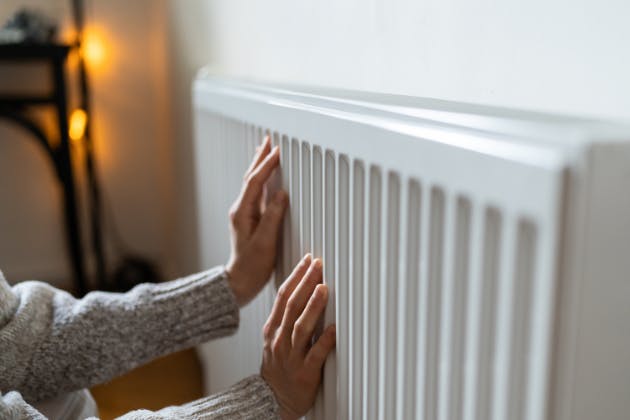
If the top of a radiator is cool and the bottom is hot, it likely has air trapped inside. Bleeding releases the air so hot water can circulate properly again.
What you need: radiator bleed key, an old cloth or small towel, and a container or tissue to catch any drips.
How to bleed a radiator safely:
Turn off the heating and allow radiators to cool so you do not get scalded.
Locate the small square bleed valve at the top corner of the radiator.
Hold the cloth under the valve, insert the key and turn it slowly anticlockwise.
You should hear a hiss of air. Once water starts to come out in a steady trickle, turn the valve back clockwise to close it firmly, but do not overtighten.
Check the boiler pressure afterwards. If it has dropped below the recommended level, follow your manual to top it up if you feel confident, or call an engineer.
If you have to bleed radiators frequently, or you hear a lot of gurgling and rushing noises, there may be a bigger problem such as air being drawn into the system or sludge. That is a good time to call a heating specialist.
Thermostatic Radiator Valves: How to Check for a Stuck Pin
Many modern radiators have a thermostatic radiator valve (TRV) with numbered settings on the side. If one radiator stays cold while others are hot, the TRV on that radiator may be stuck closed.
First, turn the TRV fully up to its highest setting. Give it a few minutes to see if the radiator warms. If not, you can try freeing the pin, but only if you feel comfortable.
How to check a TRV pin:
Turn off the heating and let the radiator cool. Carefully unscrew the plastic TRV head (usually a retaining ring at the bottom). Underneath you will see a small metal pin in the valve body. This pin should move up and down a few millimetres if you gently press it.
If it is stuck, gently press it in and let it spring back, repeating a few times. Do not use tools or force the pin, as you can damage the valve and cause a leak. Once it moves freely, refit the TRV head and test the radiator again.
If the valve leaks, the pin will not move, or the radiator still does not heat, turn the valve off if possible and contact a heating engineer.
Lockshield valves and balancing radiators
The lockshield valve is the other valve at the end of the radiator, usually with a plastic cap or a small square head that needs a spanner. It controls how much water flows through the radiator and is used to balance the system so all rooms heat evenly.
If a radiator has been removed or worked on, its lockshield may have been left fully closed, so no hot water can pass through.
Carefully checking a closed lockshield
If one radiator is cold from top to bottom, and the pipes either side are cold too, you can check the lockshield position:
Remove the plastic cap if there is one. Using an adjustable spanner or small pliers, turn the square or hexagonal spindle very slightly anticlockwise, perhaps a quarter turn at a time. Give the system a few minutes to respond.
If the radiator begins to warm, the valve was probably shut. Do not open it several turns at once, or you may unbalance the system so other radiators suffer. Full system balancing, where each radiator is adjusted and checked in sequence, is best left to a professional with the right thermometers and experience.
If adjusting the lockshield on one radiator affects others, or you are unsure about which way to turn it, stop and arrange a visit from an engineer.
Sludge, magnetite and when to suspect a deeper issue
Over time, heating systems can build up sludge, often a dark brown or black magnetic deposit called magnetite. This restricts flow, leaving radiators cold at the bottom and warm at the top, or causing some radiators to never heat fully.
Signs that sludge may be present include very slow warming radiators, cold patches that bleeding does not fix, and radiators that feel hot at the top corners but cool across the centre and bottom.
If you need to remove a radiator for decorating and the water that comes out is thick, very dark brown or black, or gritty, that is a clear indicator that you should call a professional. Repeated air build-up and noisy pipework can also point to circulation issues or pump and valve problems that are not a DIY job.
Simple tools that help with radiator checks
You do not need specialist kit to carry out most basic radiator checks, but a few simple tools make the job easier and safer.
It is helpful to have a radiator bleed key, an old towel, a flat-head screwdriver for some lockshields, an adjustable spanner and, if you can, a basic digital thermometer to compare radiator temperatures. Always protect carpets and nearby surfaces, and take care with hot surfaces and water.
Prevention tips to keep radiators heating properly
Once your radiators are working again, a bit of preventative care will help keep them that way. Heating systems are more efficient and reliable when they are clean and treated correctly.
Arrange an annual boiler service so a qualified engineer can check safety, combustion, controls and circulation. They can also advise if your system pressure or settings need adjusting.
Make sure your system has a corrosion inhibitor added to the water to slow down sludge build-up. Many homes also benefit from a magnetic filter fitted on the pipework near the boiler to catch magnetite before it reaches your radiators.
Where there is long-standing sludge or very uneven heating, a professional may recommend a powerflush to clean the system. This should only be carried out by a trained engineer using suitable equipment and chemicals, and only after they have confirmed it is appropriate for your boiler and pipework.
When to call a professional heating engineer
Stop troubleshooting and book a professional if you notice any of the following:
Boiler error codes you do not recognise, or the boiler will not stay on
Radiators repeatedly need bleeding or you hear loud banging, clanging or gurgling
Brown or black water when bleeding or removing radiators
Suspected pump, motorised valve or control issues
You feel out of your depth adjusting valves or balancing the system
If your radiator still is not heating properly after these checks, it is safer and usually quicker to get an expert involved.
Pegasus Plumbers Ltd can help with radiator faults, boiler problems and full heating system checks. If your own troubleshooting has not solved the issue, call 07584495834 or book online via our contact page. For long-term peace of mind, you can also arrange regular maintenance with our boiler servicing service to keep your heating running smoothly.